Excerpt:
How low-latency embedded architectures enable natural and responsive prosthetic control.
Content:
Introduction
High-performance prosthetic control is not defined only by signal interpretation.
It depends on how fast and reliably the system processes data in real time.
At TRYZMEY, we design embedded architectures that prioritize low latency, signal stability, and computational efficiency.
Why Latency Matters
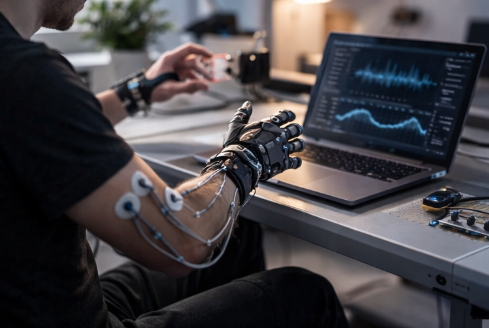
In human–machine interaction, even small delays can disrupt natural movement.
A control delay of just a few milliseconds can result in:
- Reduced precision
- User discomfort
- Cognitive overload
- Decreased trust in the system
For prosthetic users, responsiveness is not a luxury — it is fundamental.
Embedded System Architecture
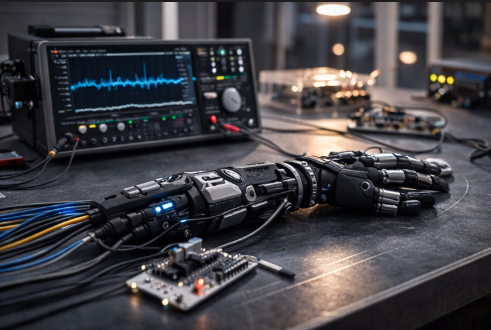
Our platforms are built around:
- Optimized real-time processing pipelines
- Low-power microcontroller integration
- Efficient signal filtering at the hardware level
- Modular firmware design
Instead of relying solely on high-level software processing, we integrate intelligence directly into embedded hardware.

Stability Under Real-World Conditions
Laboratory environments are controlled. Real-world environments are not.
Our systems are designed to operate under:
- Variable signal amplitudes
- Environmental noise
- Long-term usage conditions
- Changing muscle activation patterns
Adaptive firmware updates allow continuous optimization without hardware redesign.
Toward Intelligent Prosthetic Ecosystems
The future of prosthetics lies in integrated ecosystems where:
- Sensors
- Embedded processors
- Adaptive algorithms
- Modular hardware
work seamlessly together.
Our goal is to make embedded intelligence invisible — so the user experiences only natural motion.
Conclusion
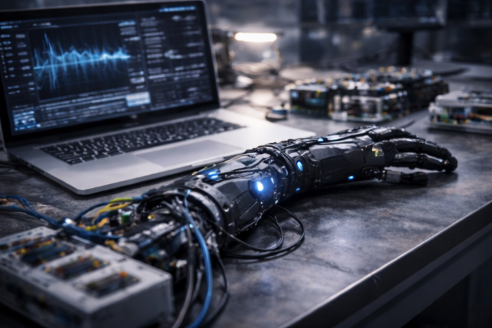
Real-time embedded systems are the backbone of intuitive prosthetic control.
When hardware and algorithms operate as a unified architecture, performance becomes consistent, scalable, and clinically viable.